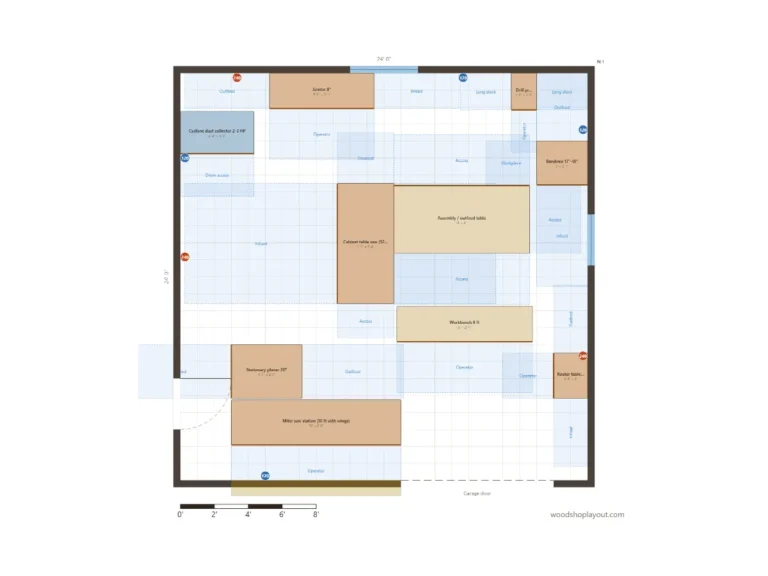
Dust collection guide · 14' × 20'
Small Shop Dust Collection Layout
In a small shop, where the dust collector stands decides how well it works. A good collector at the end of a long duct with many bends can perform worse than a smaller one placed right next to the machines. This guide shows a 14×20 ft example and the rules of thumb behind it.
Interactive preview
Explore the plan
Zoom in to see the collector, the machines around it and their working zones.
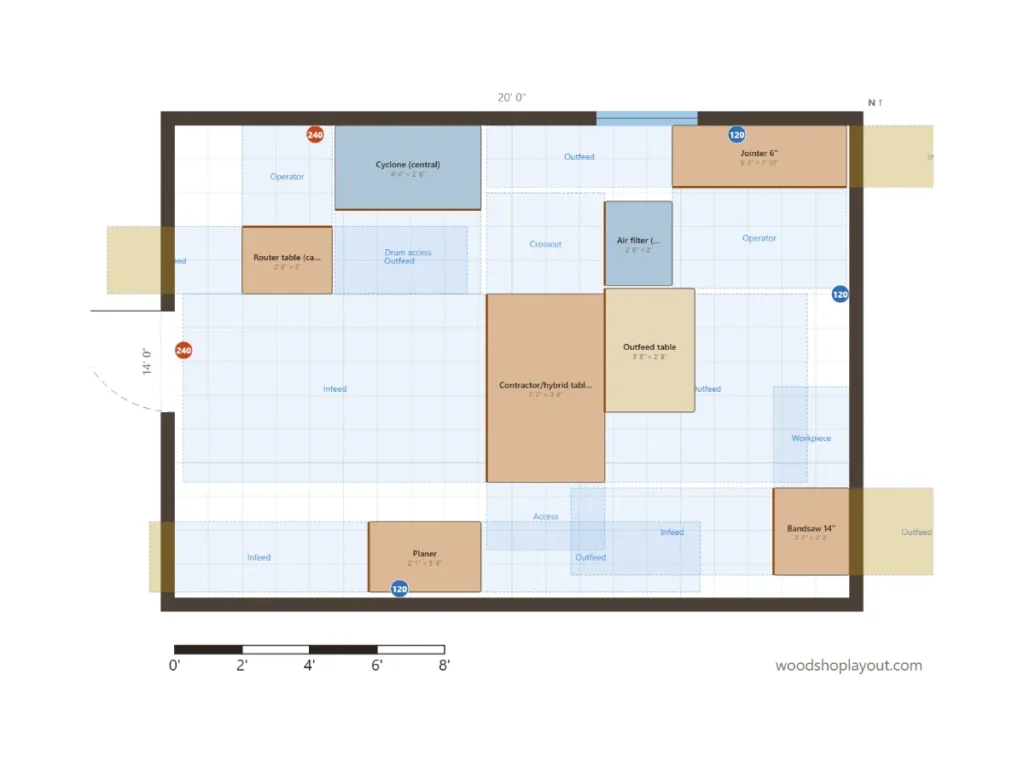
The cyclone stands on the north wall, close to the saw, jointer and planer.
The idea
How this layout works
The cyclone stands on the north wall in the middle of the machine group. The table saw is a few feet in front of it, the 6″ jointer is on the same wall, and the planer sits on the south side of the saw lane. The main duct runs along the north wall with short drops to the jointer and the saw; the planer and the router table get flexible hoses that are only connected when the machine runs.
The air filter hangs from the ceiling between the saw and the jointer, over the area where most fine dust is made. The bandsaw on the east wall is the farthest machine; it makes the least dust, so the longest branch goes there.
Rules of thumb
Where to put a dust collector
Seven rules that keep airflow high at the machine.
- Put the collector closest to the machines that make the most chips: usually planer, jointer and table saw.
- Keep the main duct short and straight. Every elbow and every extra foot of duct adds resistance and reduces airflow at the machine.
- Use long, gentle bends and 45° wyes instead of tight 90° elbows and T-fittings.
- Fit a blast gate at every machine and open only the one you are using.
- Size ducts to the collector and the machine ports, and check the collector maker's performance chart for your total duct length.
- Use short flexible hose only at the last few feet to the machine; long flex hose costs a lot of airflow.
- Leave access to empty the bin or bag, and keep the collector away from the door path.
Collector types
Which collector fits a small shop?
Shop vac + cyclone separator
Good for sanders, routers, track saws and benchtop tools with small ports. Easy to move from tool to tool.
Single-stage collector (1–2 HP)
Moves enough air for one large machine at a time with a short hose. Many small shops roll it to whichever machine is running.
Cyclone (2–3 HP)
The usual choice for a fixed duct system serving several machines. It separates chips before the filter, so the filter stays cleaner.
Air filtration unit
Not a replacement for collection at the machine, but it helps with the fine dust that stays in the air after you stop working.
Fine dust is the part you cannot see and the part that matters most for your lungs. Whatever system you choose, a good dust mask or respirator is still a sensible addition.
Your turn
Plan your own dust collection layout
Open this example, change the room to your size and move the collector until it sits next to your biggest chip makers. The planner shows each machine’s working zones, so you can see whether ducts and hoses would cross a walkway.
Keep exploring
More woodshop layouts
10' × 12'
Small woodshop
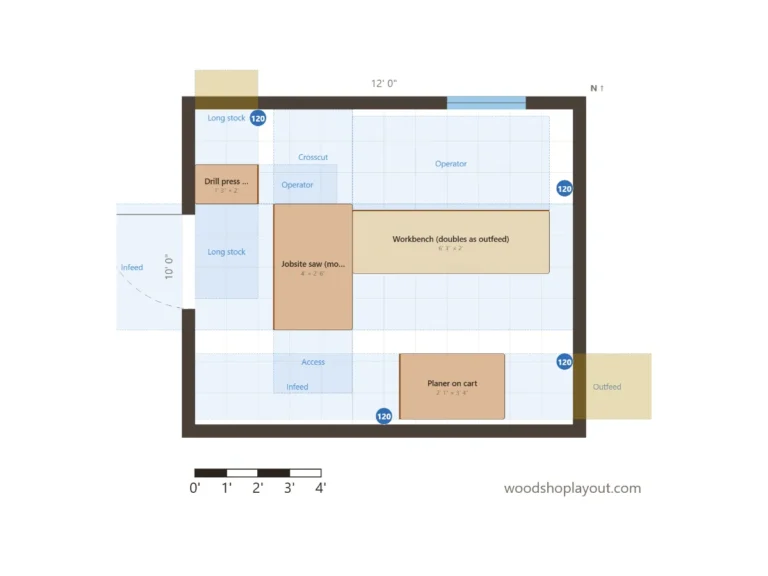
Jobsite saw that rips through the door, bench as outfeed, tools on carts.
View layout →
12' × 16'
12x16 wood shop
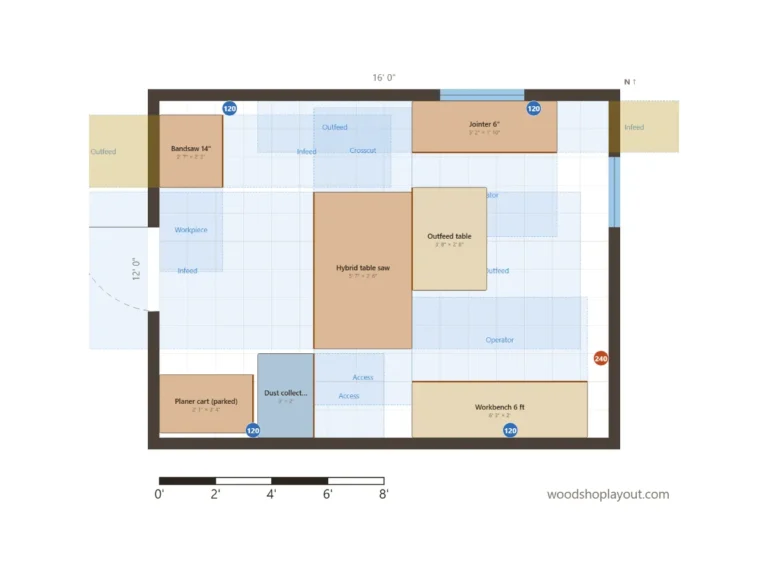
Hybrid saw in the middle, jointer on the wall, planer on a cart.
View layout →
24' × 24'
24x24 wood shop
Assembly table as outfeed, cyclone next to the big machines.
View layout →