Woodshop layout example · 12' × 16'
12x16 Wood Shop Layout
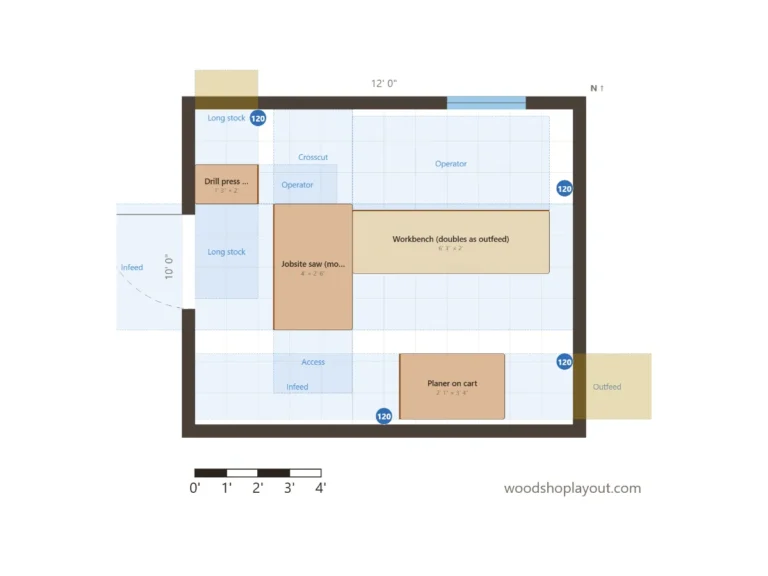
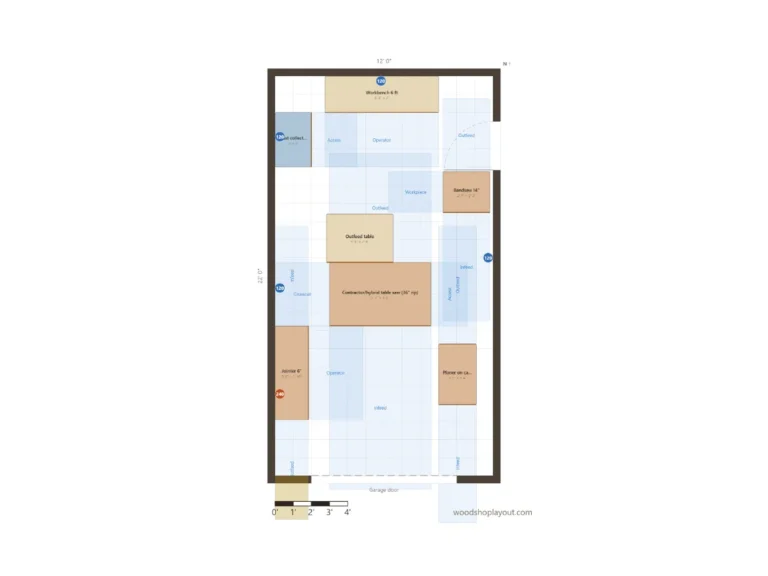
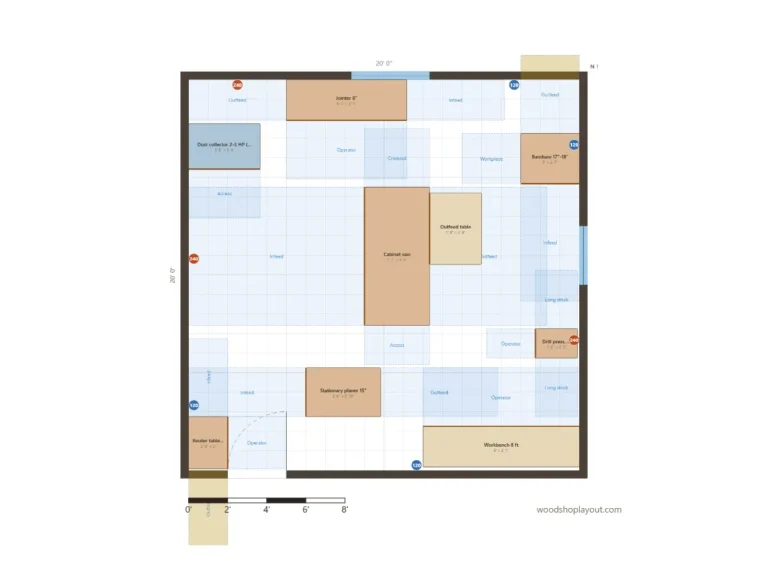
A 12×16 shop is about 192 square feet: enough for a real table saw, a jointer, a bandsaw and a bench, as long as every machine earns its spot. This example layout puts the saw in the middle and uses the entry door as the infeed for long rips. Open it in the planner and move things around to fit your own walls, doors and outlets.
Interactive preview
Explore the plan
Zoom in to read every machine and zone. Open it in the planner to move things around.

Workflow
How this layout works
The plan follows the order wood moves through a small shop:
- Lumber in through the 36″ door on the west wall. Long boards go straight into the table saw’s infeed lane.
- Breakdown and ripping at the hybrid table saw in the center. The saw faces the door, so the door is your extra infeed space when you rip 8 ft stock.
- Milling at the 6″ jointer on the north wall and the benchtop planer, which lives on a cart in the southwest corner and rolls into the open lane when you need it.
- Curves and resawing at the 14″ bandsaw in the northwest corner.
- Assembly and finishing at the 6 ft workbench on the south wall. Finish with the door open, or move finishing outside.
Machine placement notes
- Table saw: about 5½ ft from the blade side of the saw to the west wall, plus the open door, and about 7 ft from the back of the saw to the east wall. The outfeed table sits directly behind the blade.
- Jointer: the bed runs along the north wall with roughly 5½ ft of infeed room. Longer boards are easier if you cut parts to rough length first.
- Bandsaw: in the corner with its back to the wall. Keep the area in front clear; that is where the board swings during a cut.
- Planer: parked on a cart. Roll it into the saw lane, which gives full-length infeed and outfeed in both directions.
- Workbench: 3 ft of standing room in front, which is also the main walkway.
Dust and power
Dust collection and power
The 1.5 HP single-stage collector stands against the south wall right next to the saw, so the hose to the saw stays short. Move the hose to the jointer or planer as you use them. In a shop this size, one collector with a short flexible hose and a separate shop vac for sanders is usually simpler than a ducted system.
All tools in this example run on 120V. The outlet plan has 120V outlets on the north and south walls and one 240V outlet on the east wall, ready for a later cabinet saw or a 2 HP collector. Mark your real outlets in the planner before you move machines; a cord across a walkway is a trip hazard.
Your turn
Customize it for your shop
Change the room size, move the door, swap the hybrid saw for a jobsite saw or a cabinet saw, and type in the real footprint of your machines. Red marks mean a machine is standing in another machine’s working zone; yellow is only a hint. When it looks right, copy the share link and ask for feedback in your favorite woodworking forum.
Keep exploring